


10 Nov Back to long distance with the A2 stock
Back to long distance with the A2 stock

Andreas Webner
For Andreas Webner, sport has always been an essential part of his life, even though triathlon came relatively late. He started running marathons at the age of 36 before competing in his first long-distance triathlon in Roth, Middle Franconia, in 2013: a 3.8 km swim, a 180 km bike ride, and a 42.2 km run. Since then, he has completed several Ironman competitions in Germany and around the world: “I kept a list until 2020. By then, I had already run around 50,000 kilometers,” Webner summarizes. The former sales representative has now completed 83 marathons, 11 of which were combined with a long-distance triathlon.
Around 15 years ago, the first signs of osteoarthritis appeared: “I’d get occasional twinges, then it would be fine again. At the beginning of 2023, the symptoms worsened. It was manageable when my muscles were warm and moving. But after competitions, it took me longer and longer to recover,” Webner explains. Some movements were no longer possible before the surgery, such as getting in and out of the car or tying my shoes.
Dr. Alexander Moser, a hip specialist in Berlin sportorthopaedie.berlin, recalls the initial consultation in April 2023: “Mr. Webner exhibited severely restricted hip joint movement with incipient joint stiffness. He also experienced start-up pain and pain after exertion.” Webner’s quality of life was significantly impaired. Despite his excellent physical condition, the joint degeneration had so severely compromised his function that a total hip replacement was the only viable solution. The surgery was scheduled for October 2023.
Modern endoprosthetics allows for a more nuanced perspective on sports
But how do you care for an enthusiastic triathlete? For many years, orthopedic surgeons have advised their patients to only participate in moderate sports after receiving a hip replacement. “Today, we take a more nuanced view. Modern implants and precise surgical techniques allow even endurance athletes to return to top-level performance after hip replacement surgery. If the implant has healed well and the musculoskeletal system has been stabilized, the limitations are much less than they were a few years ago,” says Dr. Moser.
Dr. Moser specialized entirely in the conservative and surgical treatment of hip disorders several years ago. He is particularly passionate about providing individualized consultations to athletes with hip problems. “The specific needs of each athlete must be taken into account: Where are they in their athletic career? What goals are they pursuing? Is major surgery even advisable for them at this point?”
Dr. Moser recalls that Webner was in excellent physical condition at the time of the surgery. “The individual situation is crucial: age, training level, technique, and the patient’s goals all play a significant role. Therefore, the return to sports should always be discussed closely with the surgeon.”
The A2® Short Stem as an Option for Athletically Active Patients
In Mr. Webner’s case, the goal was to preserve the natural biomechanics of the hip as much as possible and to reconstruct the movement patterns. “That’s why I opted for the A2® Short Stem. The implant very precisely mimics the natural anatomy and can be inserted via a minimally invasive, anterior approach. For an enthusiastic athlete like Mr. Webner, this means not only muscle preservation and faster recovery, but also an excellent foundation for subsequent athletic activity,” explains Dr. Moser.
For an endurance athlete like Webner, durability plays a crucial role, explains Dr. Moser. “The A2® short stem anchors itself in a short section of bone, thus preserving the bone’s natural elasticity. This is important for the stresses of sports. Together with the appropriate cup component and a high-quality bearing surface, we can achieve very low wear and tear, resulting in a long prosthesis lifespan. Therefore, the system is very well suited for athletically active patients.”
Returning to Sports: With Patience and a System
Around two years after the surgery, Andreas Webner is now “super happy” with his mobility: “I don’t even notice the new hip, and my mobility is back to what it was 15 years ago.” His hip didn’t give him any trouble during the triathlon challenge in Roth. “That was an emotional experience,” he recalls.
To make this possible again, Dr. Moser had thoroughly explained the post-operative stress phases to his patient: “The crucial period is the first few weeks, during which the socket integrates with the bone. While the leg can bear weight during this phase, strenuous activity should be strictly avoided. After about three months, light exercise – such as cycling or swimming – is generally possible again. We deliberately waited a bit longer before resuming running, starting slowly after about six months. This gradual increase was essential to ensure the long-term durability of the prosthesis.”
A Triathlete’s Record
What conclusion does Andreas Webner draw today? “I kept putting off the surgery, thinking: the later you do it, the better. Looking back, I wish I had decided a year or two earlier. That would have saved me a lot of pain.” At the same time, he’s aware of the demands his sport places on his new joint: “No one can guarantee that sports won’t wear down the artificial joint. I weigh relatively little – 70 kg at 175 cm – and I do a lot of muscle training to protect the joint,” says Webner. Ultimately, it’s a combination of the implant, the patient’s discipline, and the surgeon. “And he really did a fantastic job,” Webner affirms.
Short-stem prostheses in sports orthopedics
For Dr. Moser, the short stem plays a crucial role in sports orthopedics because it is designed to preserve natural anatomy and biomechanics as much as possible: “The A2® short stem is an implant that, thanks to its wide range of options, can be securely anchored in the bone in almost any anatomical situation and, in conjunction with a suitable acetabular cup system, restores the hip’s center of rotation in three dimensions. I particularly like to use it in younger, athletically active patients because it respects the anatomical conditions and enables excellent function in everyday life and sports. For me, the greatest reward is seeing someone not only walk again after surgery but also regain their active lifestyle.”
Andreas Webner recently dismounted his bicycle at the Triathlon Challenge in Roth, and he’s already registered for the Ironman in Hamburg in June 2026. “If that’s your thing,” we could shrug. But there’s something special about the 65-year-old Webner: he practices this extreme sport with an A2® short stem hip prosthesis. We spoke with Dr. Moser, a hip specialist and sports orthopedist in Berlin, about whether and how athletes like Andreas Webner can be successfully fitted with an endoprosthesis. And we also asked Andreas Webner what his assessment of the experience is.
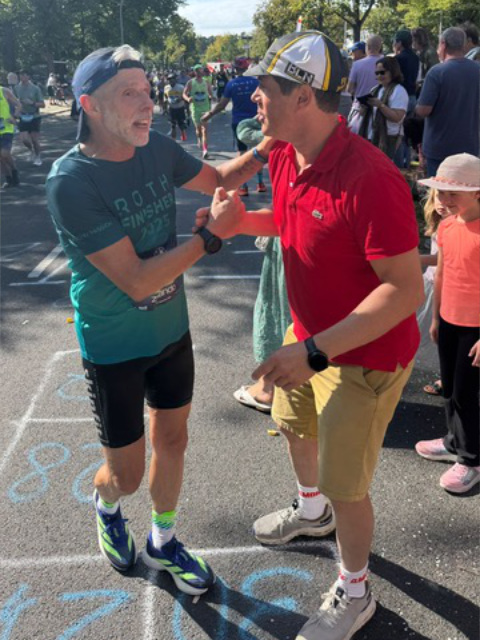
Andreas Webner and Dr. Moser

Andreas Webner

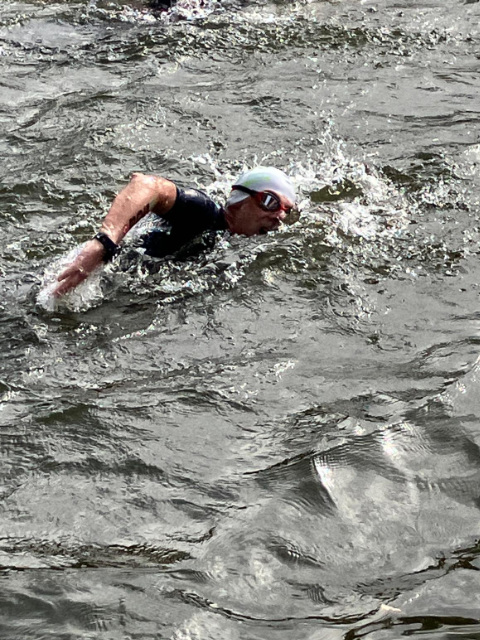
Andreas Webner at the triathlon