

23 Jun The bikini incision: When wound healing and aesthetics converge
The Bikini Incision: Where Wound Healing and Aesthetics Converge

PD Dr. Prodinger
The direct anterior approach (DAA) is now considered a standard approach in hip arthroplasty, offering a muscle- and soft-tissue-sparing technique that facilitates patient rehabilitation. However, for a growing group of patients—particularly those with obesity—the traditional longitudinal groin incision carries a specific risk: wound healing complications caused by skin folds overlying the incision. For these patients, PD Dr. Peter Prodinger, Chief Physician of Orthopedics and Trauma Surgery at Agatharied Hospital, employs a “bikini incision” approach. In this modification of the DAA, the skin incision is made transversely, following the natural lines of skin tension. In an interview with ARTIQO, he explains how the technique has evolved, for whom it is suitable, and why a short-stem implant like the A2® system is highly beneficial in this context.
ARTIQO: Dr. Prodinger, when and why did you start performing implant surgery using the bikini incision?
PD Dr. Prodinger: Work on modifying the direct anterior approach in this way began about ten years ago. Together with other surgeons, I initially tested and refined the technique step-by-step at the university hospital where I was working at the time, and I have continuously developed it further over the past seven years. For approximately five years now, I have been using it in routine clinical practice at Agatharied Hospital.
ARTIQO: What were the reasons for adjusting your surgical technique?
PD Dr. Prodinger: The starting point was a specific clinical problem: The anterior approach is excellent in terms of minimizing muscle trauma and preserving nerves and blood vessels. It allows for rapid rehabilitation and significantly reduces intraoperative harm to the patient. However, the classic longitudinal incision in the groin runs exactly where obese patients often have a lower abdominal skin fold that crosses the incision line. We frequently observed wound healing complications in this area—ranging, in the worst cases, to deep infections involving the prosthesis.
The question was: How could we retain the benefits of the anterior approach while minimizing this specific risk? A group of surgeons—including colleagues from Switzerland—began making the skin incision transversely, following the natural lines of skin tension. This significantly improved wound healing outcomes. A welcome side effect was that, over time, the scar became hidden within a natural skin fold and was barely visible cosmetically. Cosmetic appearance was never the primary goal, but it did lead us to increasingly use the technique on non-obese female patients who were concerned about aesthetics.
ARTIQO: How does the bikini incision differ anatomically from the classic DAA?
PD Dr. Prodinger: Essentially, the bikini incision is very similar to the DAA. The crucial difference lies solely at the skin surface: the skin incision is made transversely, while everything beneath it proceeds in the conventional manner—that is, longitudinally. The transverse skin incision offers cosmetic benefits and advantages for wound healing, but it carries the risk of severing superficial cutaneous nerves if made too deep. Therefore, the transverse approach is strictly limited to the skin.
For the patient, this means that the benefits of the anterior approach—minimal muscle trauma, rapid mobilization, and reduced need for painkillers—are fully preserved. Added to this are the advantages of improved wound healing and, where relevant, a more aesthetically pleasing result.
ARTIQO: How does the intraoperative view change, and what does this mean for the surgeon?
PD Dr. Prodinger: I want to be very clear on this point: operating via a transverse incision is significantly more challenging than via a longitudinal incision. Visibility is considerably reduced. The view of the acetabular cup position and the femoral stem bed is restricted. There is a real risk of malpositioning the cup—regarding both inclination and anteversion. The same applies to stem implantation.
Another practical issue concerns the stem: when inserting a conventional straight stem, the cranial skin edge often gets in the way. This makes implantation more difficult. Furthermore, extending the approach—for instance, in the event of unexpected intraoperative complications such as a periprosthetic fracture—is more complex with the bikini incision than with the standard DAA: while it is possible to extend the incision in a Z-shape cranially and caudally, one does not have the same flexibility as with a longitudinal incision.
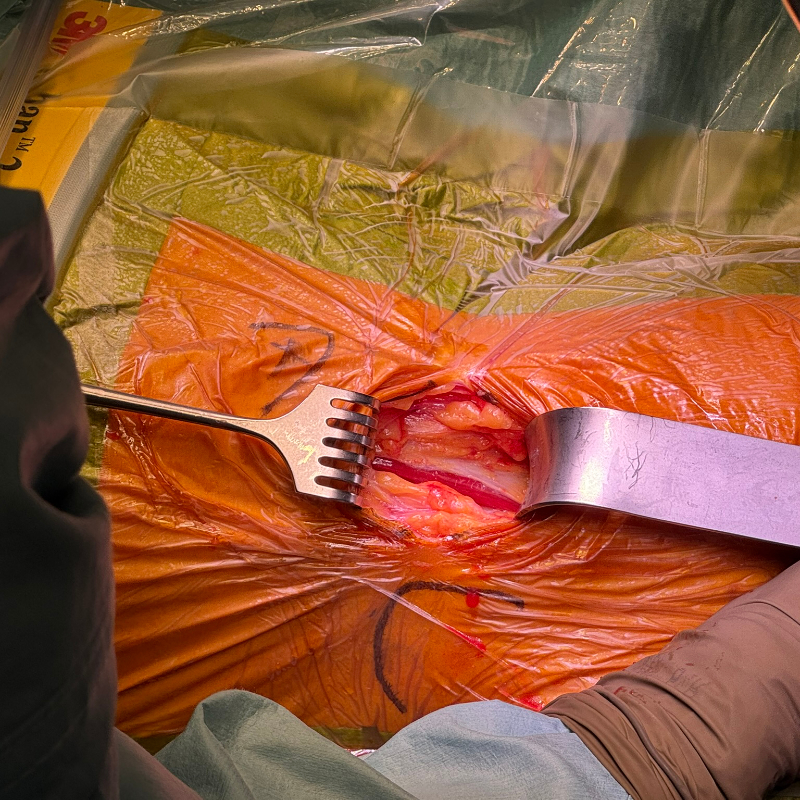
Transverse skin incision with opening of the fascia
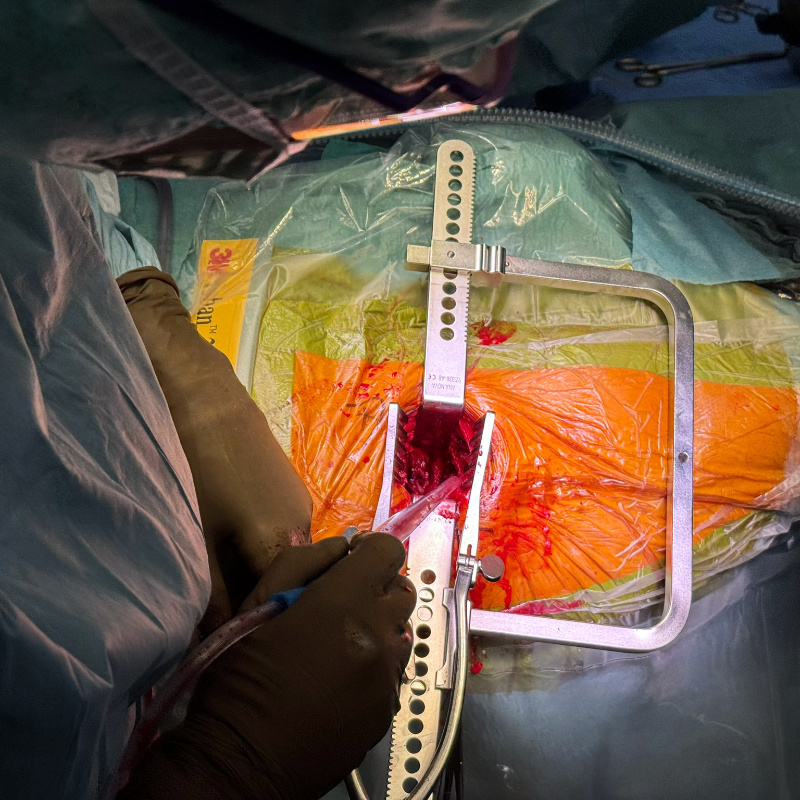
Access to the hip joint following soft-tissue dissection and prior to femoral head resection.
ARTIQO: What demands does the bikini cut place on the socket design?
PD Dr. Prodinger: A short-stem system like the A2® short stem, with its anatomically curved design, can be inserted via the bikini incision without conflicting with the cranial skin edge. Figuratively speaking, you can insert it along a curved path and prepare the canal with a correspondingly curved rasp. This significantly reduces mechanical stress on the skin.
Another advantage of the bikini incision is that the femoral neck osteotomy plane is clearly visible through this approach. This provides a reliable reference point for stem positioning, even though the overall view is limited. The available field of view is sufficient for correct short-stem implantation—provided one is very familiar with the implant.
Inserting a straight stem via the bikini incision is considerably more difficult and requires more experience.
ARTIQO: For which patient groups do you recommend the bikini incision?
PD Dr. Prodinger: Primarily for two groups: First, obese patients—specifically those at increased risk of wound healing complications due to body weight or body shape. It is important to note here that the ventral soft-tissue layer is generally thinner than the lateral or dorsal layers; thus, the anterior approach offers anatomical advantages for obese patients. Second, female patients with specific cosmetic preferences who explicitly request the “bikini incision” after receiving detailed information.
At Agatharied Hospital, I now routinely perform surgery on all women using the bikini incision, regardless of body weight. This also applies to severely obese male patients. Of the approximately 300 total hip arthroplasties I perform annually, around 150 to 200 are implanted using this approach.
An important point: For female patients requesting the bikini incision for cosmetic reasons, the patient education process must be adapted accordingly. The procedure is technically more demanding as a result. Furthermore, experience shows that lymphatic swelling in the leg may persist slightly longer with this approach than with the conventional DAA. The risk of injury to the lateral femoral cutaneous nerve—potentially causing temporary sensory disturbances on the outer thigh—is a general risk associated with the anterior approach, regardless of whether a transverse incision is used.
ARTIQO: What advice would you give to colleagues who are considering adopting the bikini-incision technique?
PD Dr. Prodinger: My most important piece of advice is this: anyone wishing to adopt the “bikini incision” should already have truly mastered the direct anterior approach (DAA) with confidence and routine proficiency. The transverse incision makes the technique more difficult, not easier. If you still have any uncertainties regarding the DAA, you should not attempt to introduce the bikini incision as well.
Furthermore, I strongly recommend being thoroughly familiar with the specific implant you intend to use.
In practical terms, I recommend first observing a surgeon who routinely uses the bikini incision; watch how the incision is placed, what the setup looks like, and what matters most during the procedure. Then, I would start with suitable patients: anatomically straightforward cases, without extreme deformities or excessively tight, muscular tissue. I would explicitly advise against starting with male patients. Female soft tissue is more pliable and easier to retract, which significantly facilitates exposure. A somewhat heavier patient with uncomplicated anatomy makes for a suitable starting case.